
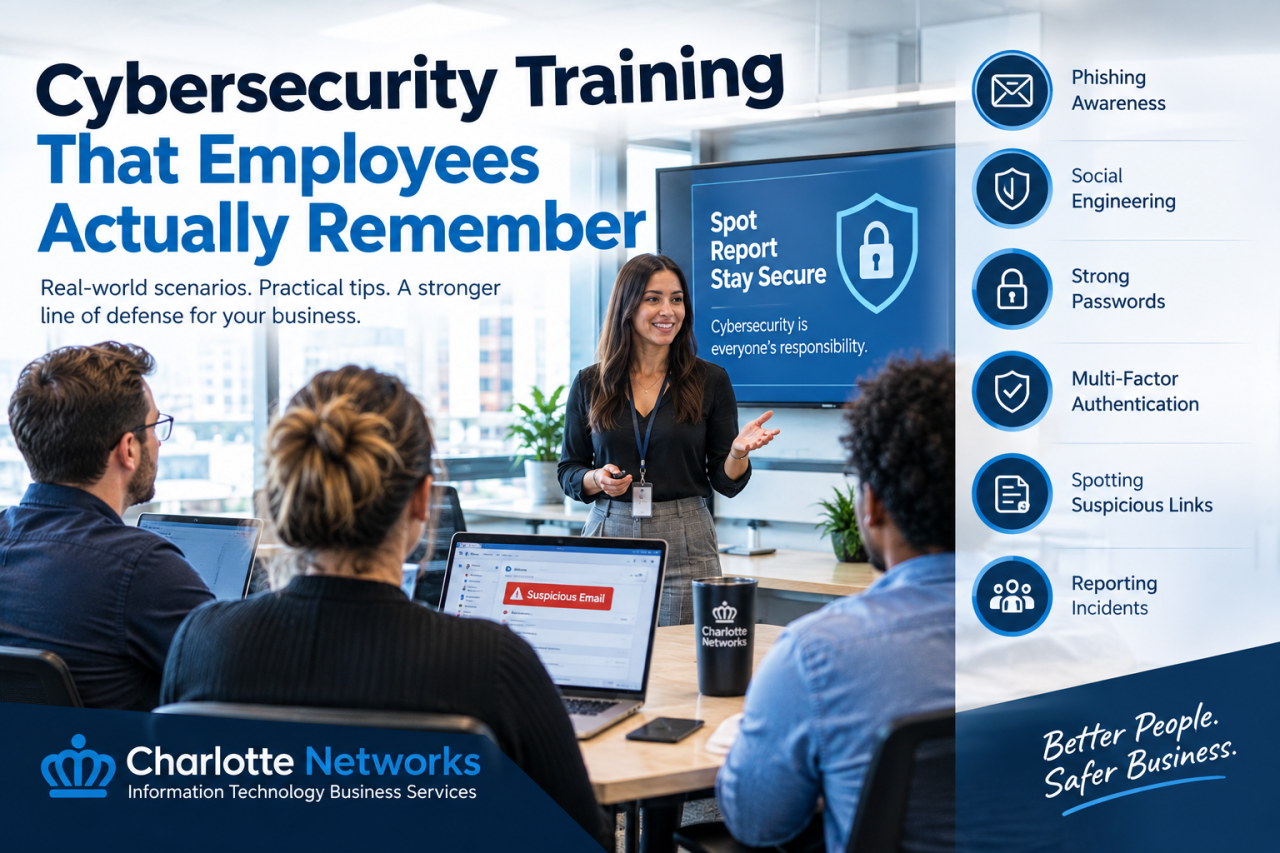
Cybersecurity Training That Employees Actually Remember
Your employees are one of your company’s greatest assets.
They’re also one of your most important cybersecurity defenses.
Unfortunately, traditional cybersecurity training doesn’t always stick. Asking employees to sit through a long presentation once a year and click through a compliance video isn’t necessarily enough to prepare them for the increasingly convincing phishing emails, suspicious links, fake login pages, and social engineering attacks they may encounter every day.
Effective cybersecurity training should be ongoing, practical, and easy to remember.
The goal isn’t to turn every employee into a cybersecurity expert.
The goal is to help employees recognize suspicious activity, slow down before clicking, and know what to do when something doesn’t look right.
For small and midsized businesses, a strong security awareness training program can be an important layer of a broader cybersecurity strategy.
Why Traditional Cybersecurity Training Doesn’t Always Work
Think about the typical employee cybersecurity training experience.
An employee receives an email saying:
“Your annual security training is due.”
They click the link, watch a series of videos, answer a few questions, and receive a completion certificate.
A few months later, they may have forgotten most of what they learned.
The problem isn’t necessarily the employee.
People learn better when training is relevant, practical, and reinforced over time.
Cybersecurity awareness shouldn’t be treated as a once-a-year checkbox. Employees should have opportunities to recognize and respond to realistic situations throughout the year.
Employees Don’t Need to Become Cybersecurity Experts
Your employees don’t need to understand encryption algorithms, network architecture, or advanced malware techniques.
They need to recognize common warning signs.
For example:
An unexpected password reset email
An employee receives an email claiming their Microsoft 365 password will expire today.
The message contains a button asking them to sign in.
Instead of immediately clicking, the employee should know to stop and verify the message.
An urgent request from the CEO
An employee receives a message appearing to come from the company’s owner:
“Are you available? I need you to purchase several gift cards immediately.”
The employee should recognize that urgency and unusual requests can be warning signs of impersonation.
A suspicious invoice
An accounting employee receives an invoice from a familiar-looking vendor, but the payment instructions have suddenly changed.
Instead of processing it automatically, they should know to verify the request through a trusted communication method.
These are the kinds of scenarios that effective employee cybersecurity training should address.
Phishing Simulations Make Training More Practical
One of the most effective ways to reinforce security awareness is through simulated phishing exercises.
A phishing simulation can send employees realistic but harmless test emails designed to mimic common attacks.
Examples might include:
- Fake Microsoft 365 login notifications
- Password expiration messages
- Package delivery notifications
- Fake invoices
- HR requests
- Shared document notifications
- Account security alerts
- Executive impersonation attempts
The purpose isn’t to embarrass employees.
It’s to create a safe environment where employees can practice identifying suspicious messages before a real attacker tries it.
The Goal Isn’t to Catch Employees
Security awareness training works best when employees understand that phishing simulations aren’t a “gotcha.”
The objective is education.
If someone clicks a simulated phishing email, that’s an opportunity to teach them what warning signs they missed.
For example:
What should have raised suspicion?
- Was the sender address unusual?
- Was the message creating unnecessary urgency?
- Did the link go somewhere unexpected?
- Was the employee asked to provide credentials?
- Was the request unusual for that person or department?
- Did the email contain spelling or formatting inconsistencies?
The employee can learn from the experience without the consequences of a real attack.
Repetition Helps Employees Build Better Habits
Cybersecurity awareness is similar to many other workplace skills.
You don’t teach someone something once and expect them to remember it forever.
Security awareness should be reinforced throughout the year.
Short, recurring training can cover topics such as:
Phishing
How to identify suspicious emails, links, and attachments.
Password Security
Why employees should use strong, unique passwords and avoid password reuse.
Multi-Factor Authentication
Why MFA is important and what employees should do if they receive an unexpected authentication request.
Social Engineering
How attackers manipulate people using urgency, authority, fear, curiosity, or familiarity.
Business Email Compromise
How criminals can impersonate executives, vendors, or customers to trick employees into sending money or information.
Safe Browsing
How malicious websites and downloads can put company devices at risk.
Reporting Suspicious Activity
Perhaps most importantly, employees should know who to contact when something doesn’t look right.
Make Cybersecurity Training Relevant to Employees
Different employees encounter different risks.
An accounting employee may be more likely to encounter fraudulent invoices or payment requests.
An HR employee may receive malicious resumes or documents.
An executive may be targeted by impersonation attacks.
A salesperson may receive suspicious customer attachments or links.
That’s why effective cybersecurity training for employees should connect security concepts to the situations employees actually encounter.
Instead of saying:
“Be careful with email.”
Give employees something practical:
“Before sending a wire transfer based on an email request, verify the request using a trusted phone number.”
The second instruction is much easier to understand and apply.
Teach Employees What to Do When They Make a Mistake
This is one of the most important parts of cybersecurity awareness training.
Employees need to know that reporting a mistake quickly is better than hiding it.
Imagine an employee clicks a suspicious link and enters their Microsoft 365 password.
If they’re afraid they’ll get in trouble, they might close the browser and say nothing.
That gives an attacker more time.
But if the employee immediately reports the incident, your IT or security team may be able to:
- Reset the password
- Revoke active sessions
- Review account activity
- Investigate the email
- Check for suspicious access
- Protect other accounts
- Take additional containment measures
Creating a culture where employees feel comfortable reporting suspicious activity can be an important part of your overall security strategy.
Cybersecurity Training Should Be More Than Compliance
Compliance may require certain training.
But your objective shouldn’t simply be:
“Did everyone complete the training?”
A better question is:
“Are our employees better prepared to recognize and respond to threats?”
Completion rates can tell you whether employees finished a course.
Phishing simulations and other exercises can provide additional insight into how employees respond to realistic scenarios.
Over time, businesses can use these results to identify areas where additional training may be useful.
What Does Effective Security Awareness Training Look Like?
A strong employee cybersecurity training program should be:
Ongoing
Don’t wait until the annual training deadline.
Short and Practical
Employees are more likely to retain useful information when training is focused and easy to apply.
Relevant
Use examples that employees are likely to encounter in their actual jobs.
Interactive
Phishing simulations and realistic scenarios allow employees to practice instead of simply watching.
Positive
The goal is to improve employee behavior—not create fear.
Measurable
Businesses should be able to identify trends and areas where additional education may be needed.
Cybersecurity Is a Team Effort
Technology can provide important layers of protection, including:
- Email filtering
- Endpoint protection
- Multi-factor authentication
- Network security
- Backup systems
- Identity protection
- Security monitoring
But technology isn’t the entire solution.
An employee who recognizes a suspicious email and reports it can become another layer of defense.
That’s why employee cybersecurity training should be integrated into your broader cybersecurity strategy.
Think of your security program as multiple layers:
Employees → Identity → Email → Devices → Applications → Network → Cloud → Data
If one layer is compromised, the others should help limit the potential impact.
How Often Should Employees Receive Cybersecurity Training?
There’s no single schedule that works for every business.
However, businesses generally benefit from moving beyond a once-a-year training model.
A security awareness program could combine:
- Regular short training sessions
- Periodic phishing simulations
- Security reminders
- New-employee training
- Targeted education based on observed risks
- Annual or periodic policy reviews
The key is consistency.
Cybersecurity awareness should become part of your company’s normal operating culture rather than an annual event employees forget about shortly afterward.
Build a Culture of Security
The strongest cybersecurity programs don’t rely exclusively on technology.
They create a culture where employees understand that security is everyone’s responsibility.
That means employees should feel comfortable asking questions such as:
“Does this email look legitimate?”
“Should I click this link?”
“I received an unexpected MFA request. What should I do?”
“Someone is asking me to change payment information. How should I verify it?”
Those questions are valuable.
It’s far better for an employee to ask for help than to assume a suspicious request is legitimate.
Charlotte Networks Can Help Strengthen Your Security Awareness Program
Cybersecurity training shouldn’t be something your employees dread.
With the right approach, security awareness training can become a practical part of your company’s cybersecurity strategy.
Charlotte Networks helps businesses strengthen their cybersecurity through managed IT services, security awareness training, phishing simulations, Microsoft 365 support, endpoint security, monitoring, and other technology services.
Our goal is to help businesses build stronger security practices while giving employees the knowledge they need to recognize today’s common cyber threats.
If your business is relying on an annual cybersecurity video and hoping employees remember it when an attacker comes calling, it may be time for a more proactive approach.
Contact Charlotte Networks to learn how security awareness training and managed IT services can help protect your business.
Need Help With Your IT?
Charlotte Networks helps growing businesses replace recurring technology problems with reliable support, stronger security, and clear ownership.
Contact Charlotte Networks